Can Listeners Tell the Difference Between AI and Human Voiceover? We Tested It.
The radio industry has been debating AI voices for years. But most of that conversation has been opinion, anecdote, and anxiety. Not data.
We wanted to know what listeners actually think. So we ran a study with 1,326 weekly radio listeners ages 18-45 across the U.S., playing the same radio scripts in two versions: one voiced by a human voice actor, one AI-generated. Half of the sample heard the human version, and half heard the AI version. Neither knew which they were getting.
Here’s what we found.
Listeners Can’t Tell the Difference Until You Tell Them
We played two clips: a station imaging spot with a gas card giveaway promotion, and a short call-to-action reminding listeners to call their mothers on Mother’s Day. Both were designed to test different use cases for AI voice in radio production. The human voiceover was performed by a professional voice actor.
Before you read another word, listen for yourself. Can you tell which is which?
Clip 1
Clip 2
The first clip in each pair is the human voice, performed by professional voiceover talent Neil Wilson. The second is AI-generated. Our study listeners heard one or the other without knowing which, and most couldn’t tell the difference.
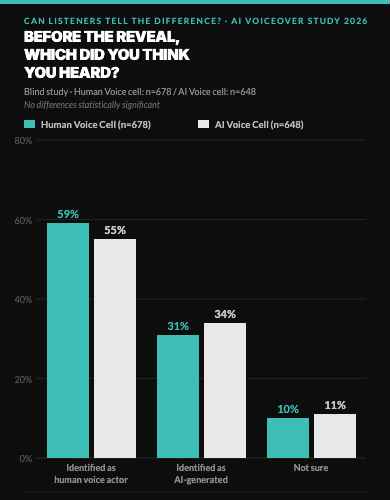
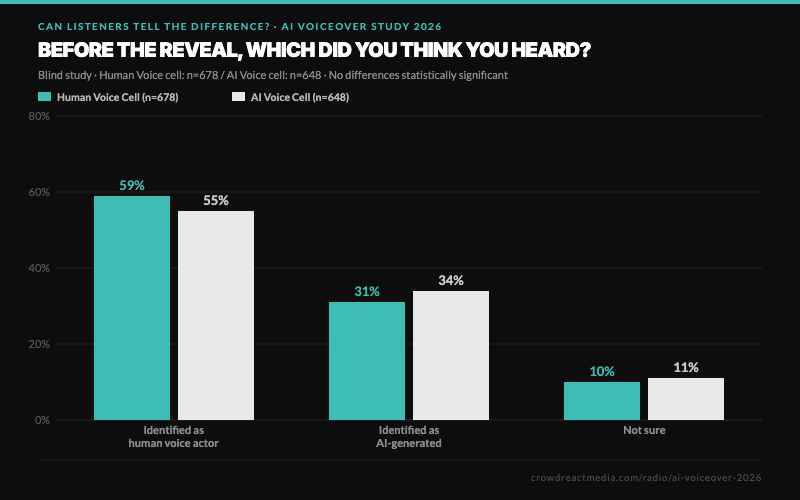
None of those differences are statistically significant. People who heard the human voice were only slightly more likely to correctly identify it as human. People who heard the AI voice were slightly more likely to think it was AI. But the margins are small enough that neither group was really “reading” the voice correctly. The AI voice passed the blind test.
Across both clips, human and AI voices scored comparably on professionalism, authenticity, credibility, energy, and likability. Not a single attribute difference reached statistical significance, with one exception we’ll get to in a moment.
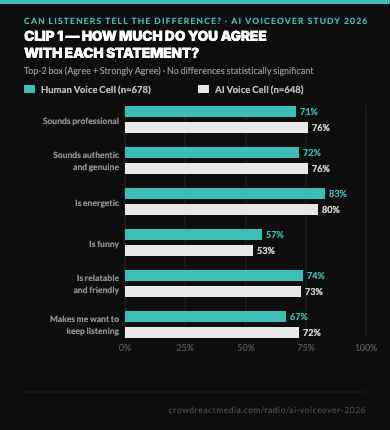
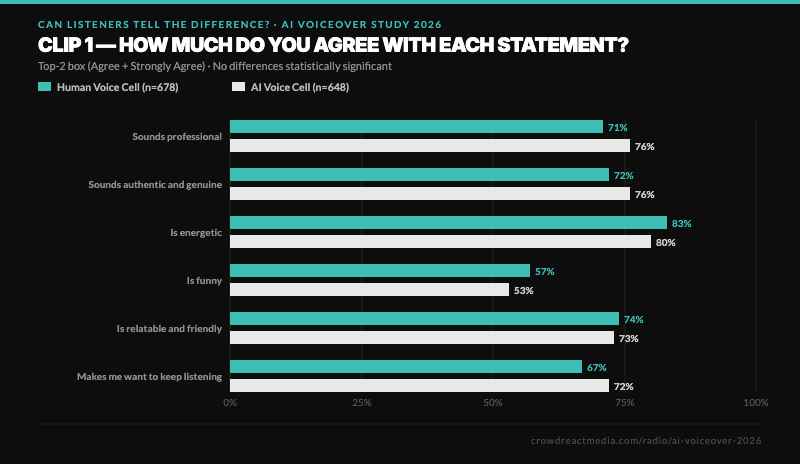
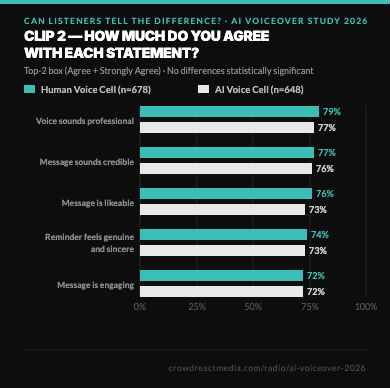
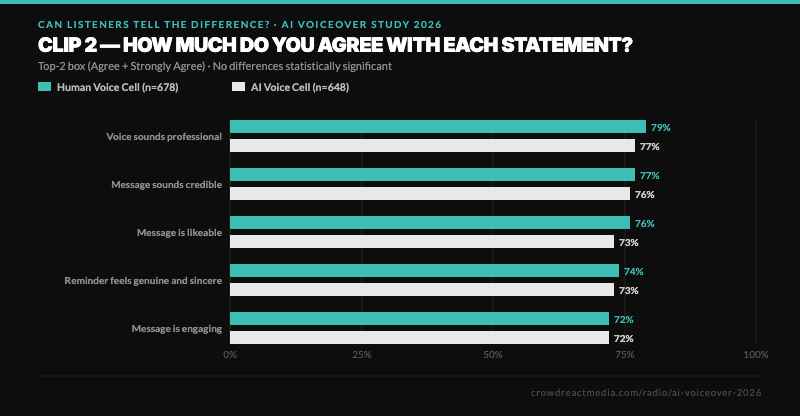
Overall appeal was virtually identical: 60% for the human voice, 61% for the AI voice on Clip 1.
Where Human Voice Measurably Won
In the Clip 1 descriptor battery, where listeners could select any words they felt applied, one result came back statistically significant…
Funny. Human voice: 33%. AI voice: 26%. A 7-point gap.
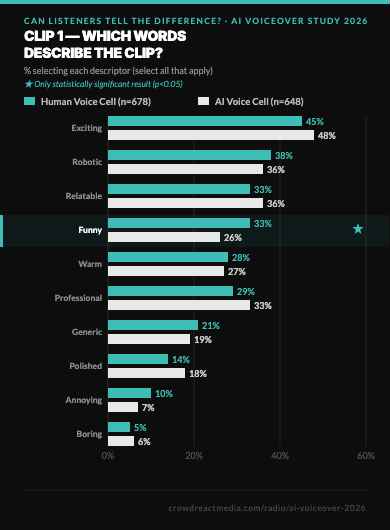
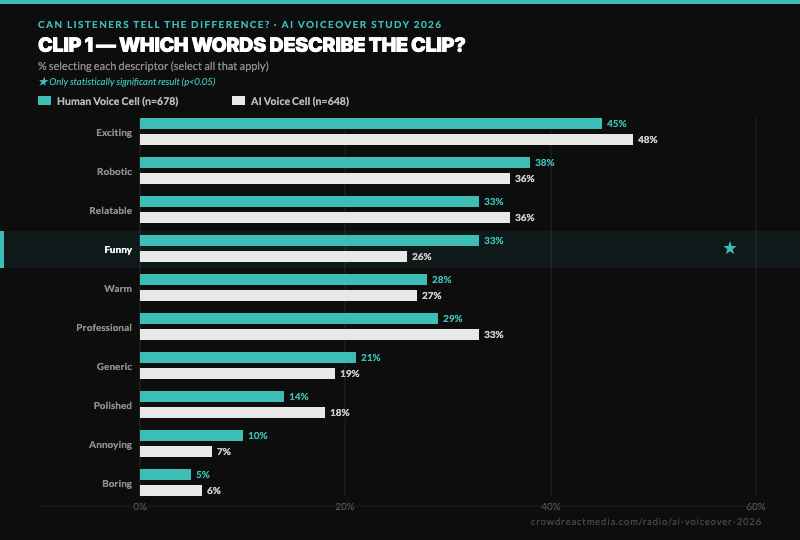
It’s the only stat-sig finding in either clip’s performance battery, and it’s notable. The human voice was perceived as meaningfully funnier. For a script built around a joke (Optimus Prius, anyone?), that landing matters. Comedy timing, inflection, and the organic quality of a human reading a punchline are things AI hasn’t fully closed the gap on yet, at least not in the ears of radio listeners.
If humor is a meaningful part of your station’s voice, this is worth paying attention to.
Everything Changed When We Told Them
After listeners rated the clips, we revealed which voice they had actually heard. Then we asked: does knowing that change how you feel about it?
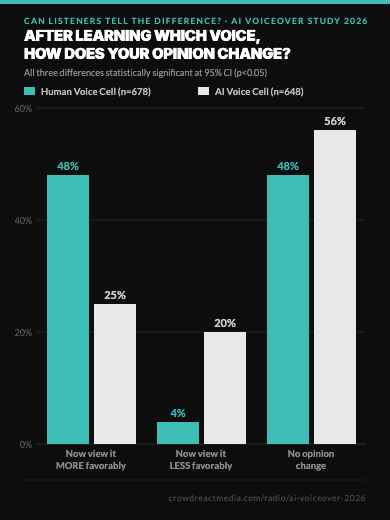
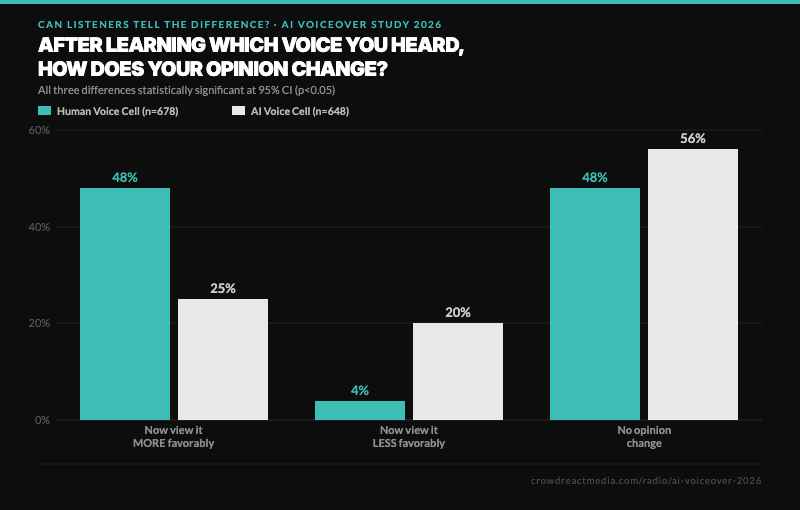
When human voice listeners found out they’d been listening to a real person, 48% felt more favorably about what they’d heard. Only 4% felt worse.
When AI voice listeners found out they’d been listening to an AI, 20% felt worse about it. Only 25% felt better, and a majority felt nothing either way.
That’s a 23-point gap in positive lift and a 16-point gap in negative reaction. Both statistically significant at 95% confidence.
The performance was the same. The perception shifted dramatically the moment people knew the source.
How Radio Listeners Actually Feel About AI Voices
We also asked the full sample a broader question: How do you feel about AI-generated voices in advertising and media, generally?
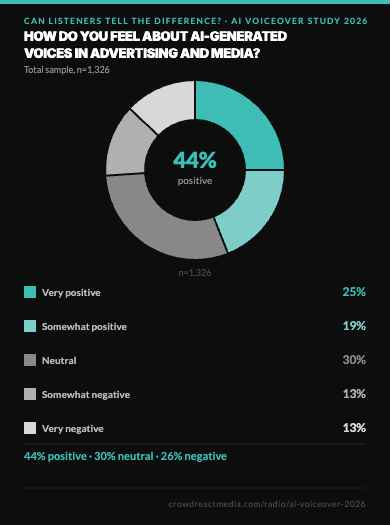
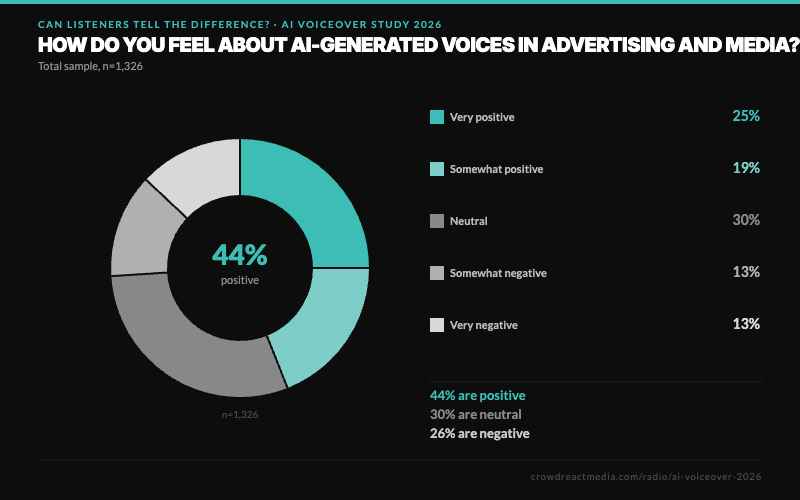
44% are positive. 26% are negative. 30% are neutral. That’s a more favorable split than you might expect given the volume of industry hand-wringing, but the negative segment is real and shouldn’t be dismissed.
And when we asked specifically about stations: Would knowing a station uses AI voices change how you feel about it?
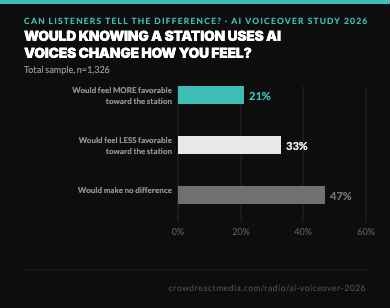
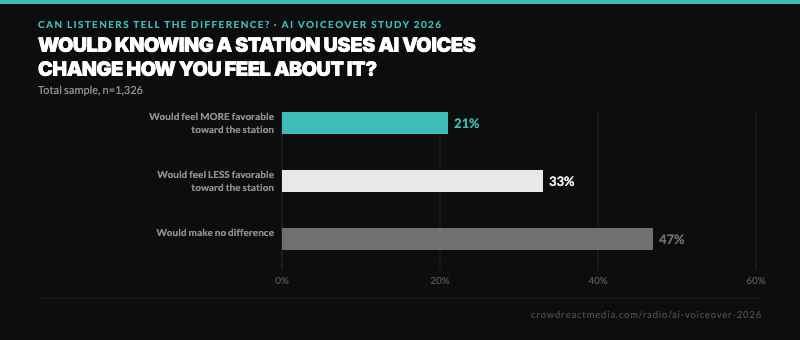
A third of listeners would feel worse about a station they found out was using AI voices. Less than a quarter would feel better. That’s an asymmetric risk.
Hearing Directly from Listeners
We also gave radio listeners a chance to weigh in after we revealed whether they had heard an human or AI voiceover.
On the human voice side, the reactions after the reveal were about connection and trust. Listeners felt validated: they liked it before, and knowing a real person was behind it made them like it more:
“I wasn’t sure if it was AI at first but now knowing it’s voiced by a live person I’m all for it!”
“It shows that some companies are still willing to do things professionally without using AI.”
“If they stay human I will keep listening!”
On the AI voice side, the negative reactions clustered around three themes: deception, jobs, and the essential nature of radio:
“Radio is about personality and connection. AI voices feel fake and less trustworthy. It would make the station feel cheap and impersonal.”
“It feels like the station is lying to listeners and I do not want to listen anymore.”
“All radio has are their voices and personalities and to lie and use fake ones is sacrilege to their listening audience.”
But not everyone in the AI cell reacted negatively. A group was genuinely impressed:
“Knowing it was AI-generated impresses me because the voice quality sounded completely natural.”
“It shows the station is innovative and cutting edge, which I totally dig.”
And some drew a line based on use case:
“Using AI for quick little blurbs or commercials is fine. But when you’re using it as a non-air personality, I believe that’s gone too far and takes away the human element of radio and entertainment.”
That nuance matters. It suggests listeners aren’t categorically opposed to AI in radio production. They’re opposed to feeling deceived, and they draw a distinction between production tools and on-air personality.
What This Means for Radio
AI voice is technically competitive. In a blind listen, it performs as well as a human voice actor on almost every measurable dimension. Stations and advertisers worried that AI voices will sound cheap or robotic may be underestimating what today’s technology can do.
Disclosure is the real variable. The performance gap is negligible. The perception gap after disclosure is substantial. If you’re using AI voice in production and listeners find out, whether through your own disclosure or through the wrong kind of attention, you’re carrying asymmetric risk. More people will feel worse than will feel better.
Humor is where human voice still has a measurable edge. For imaging built around a comedic premise, the data says keep the human in the booth.
The most negative reactions are about trust and transparency, not sound quality. The verbatims aren’t saying “it sounded fake.” They’re saying “it felt like lying.” That’s a different problem, and it points toward how stations approach disclosure, not just whether to use AI.
Credibility is worth pricing in. Yes, hiring a human voice actor costs money. But the post-reveal data shows that credibility with your audience has real value too, and it can erode fast once listeners feel deceived. Before cutting the budget on voiceover, the question worth asking is: at what point does the cost savings stop being worth the credibility risk?
This study was conducted by Crowd React Media, a division of Harker Bos Group, in May and June 2026 with 1,326 weekly radio listeners ages 18-45 across the U.S. Statistical significance tested using a two-proportion z-test, two-tailed, at 95% confidence interval (p<0.05). Human voiceover performed by Neil Wilson.